By: Courtney Joy-Breeden I Published: January 20, 2026
The Galleries at Kean have been holding exhibits for many semesters. The Fall 2025 semester was no exception, with three powerful exhibits displayed. Fall of 2025 became a time of remembrance for them; the exhibits on campus, Meryl Lettire’s “Heroes of the Holocaust”, Teddy Benfield’s “My Still Life,” and Joseph Castranova’s “In a Drop of Water”, have presented evidence that memories are precious and that art is used to materialize their beauty.
‘Heroes of the Holocaust’ — Stories Worth Seeing
At the Galleries at Kean, art is hope, and in its bi-annual collaboration with the Human Rights Institute (HRI), art becomes a voice that brings attention to injustice and creates a space for patrons to advocate for what is right. This Fall semester, these two departments collaborated in the HRI Gallery to highlight the stories of Holocaust victims and survivors through Meryl Lettire’s fabric portraits in “Heroes of the Holocaust.”
The story begins in the late 2000s, when artist Meryl Lettire, a now-retired art teacher in Somerset County, received an automated email from Kean University inviting educators to study the Holocaust and Prejudice Reduction. She took it.

“Now I’m an art teacher, not a social studies teacher, but I like clicked [and] I said yes, I’m in, and that’s how it all started,” Lettire reflects. “It changed my life.”
Lettire then discussed how she went on to create two curricula that year, concerning propaganda and artists of the Holocaust.
“I was immediately like what did artists do…I know the art of the Third Reich was propaganda [but] what did the victims do, and did they make art, and did they sacrifice to make art?”
Thus, the birth of the exhibition “Heroes of the Holocaust.”
The exhibition featured 28 powerful, multi-material portraits of teachers, clerks, writers, and many more Holocaust victims, constructed from fabric and paint.
“I found this one book, finally, called Art of the Holocaust…it has over 350 artists and their stories and their artwork, and as I said before, that was the beginning of it,” Lettire recalls.
Lettire expressed her fascination for each of the individuals featured in her work and commended their resilience and courage during a time of sorrow. These artists are people who voiced their disdain for their oppressors and noted the conditions they were living in through their art, some of them, like Felix Nussbaum, eventually being executed for their beliefs.
“Every single one of these people I kind of fall in love with, and they become heroes to me. That’s why I called it ‘Heroes of the Holocaust,’ and I admire them, and I want to know them, and I want to share their story, and I could go around here and talk about each one.”

The exhibition also features 12 portraits of women who are often overlooked as major artists. Lettire made a point to include them and their impact.
She also reflected on her time as a teacher and the bias that led many educators to call on boys more often than girls. Lettire always made a conscious effort to include the young girls in her classroom as well. That mindset has guided her throughout her career.
“First of all, I will admit, I am a feminist, and I know how hard it is for women in the arts to be recognized, so that was on my head all the way,” She said. “The first artists I was most inspired by were men, okay, and so I said ‘uh-uh,’ I’m going to find women that I admire as well.”
Interestingly, Lettire was the only major female artist featured in the galleries during the Fall 2025 semester, cementing her impact.
As the layers of fabric were compiled together to tell the stories of people who fought for their lives, it lets us not forget those before us who wholeheartedly believed in something.
“I really want [viewers] to relate to these people, I want them to see these individuals that were resilient and strong and deserve to be honored, I want them to see themselves in that, that even whatever tragedies or whatever hardship that people are under, that with our humanity we can rise above,” Lettire concluded.
‘My Still Life’ — The Resurgence of the Still Life Painter
March 2020 marked the moment when things would change forever. The month started like any other, but by the end governors and political officials all across America had shut down major businesses and academic institutions and even imposed curfews for their residents. 2020 marked the start of quarantine, a decision made following rising infection, hospitalization, and mortality rates due to SARS-CoV-2 or COVID-19.
What if you could turn back the clock or visit the version of you before everything changed? What would you see? How would you feel?
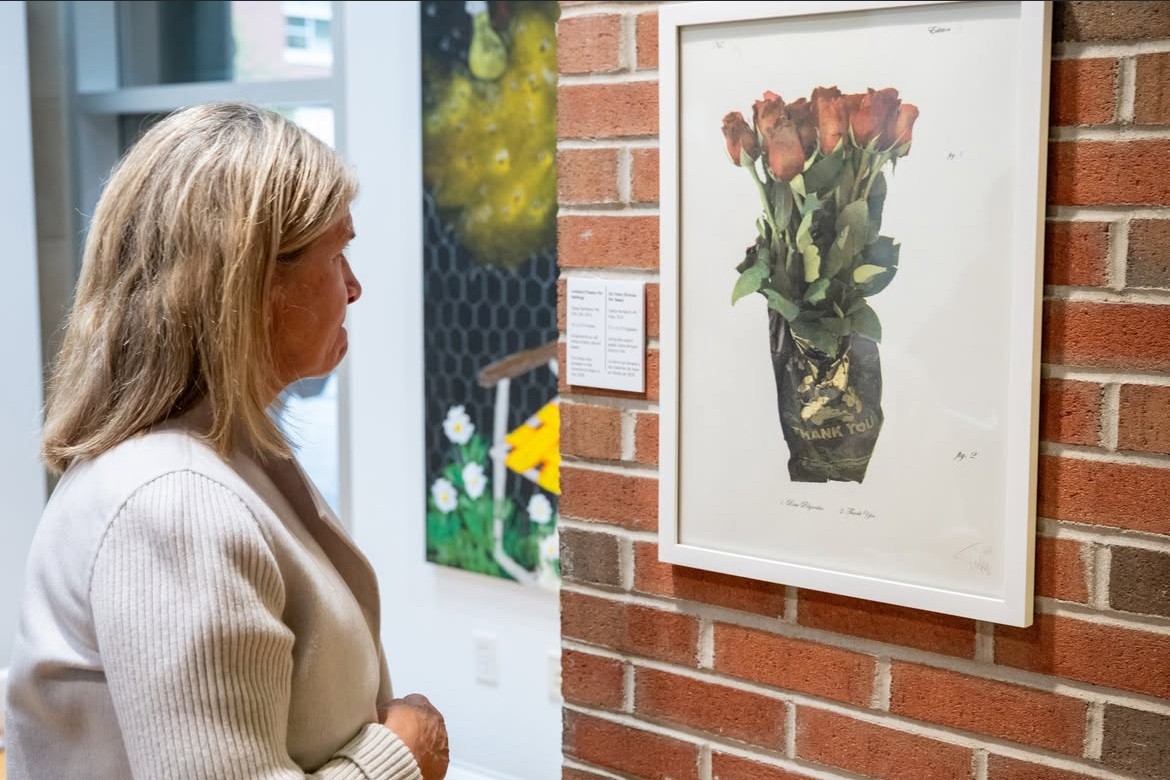
These are all questions answered by The Galleries at Kean’s newest exhibition, “My Still Life,” created by Boston-based photographer and painter, Teddy Benfield.

Described as a reflection of a “post-pandemic consciousness, where interiority serves as both a physical and psychological space” by The Galleries at Kean, the series of artworks explore some of the small moments we had pre-pandemic that have become beautiful memories we long to recreate, and some of those moments after that encouraged us to take a moment to breathe.
The art pieces are a collection of still life paintings, Benfield’s specialty.
“My work is so focused in still lifes, specifically…still life as a genre, you know, it’s sort of, over the years, it’s been forgotten, or it’s been disrespected,” he said. “If you look back at like all the famous, whether it be religious paintings or portraiture, whatever it may be, landscapes, still life has always been at the bottom there, that’s something that I‘ve always found fascinating.”
Although it’s his passion now, Benfield wasn’t always the painter he is today; his strengths lie in being the kid who found the beauty in what many kids today might simply walk past.
“I grew up really into– I still am–surfing, I used to skateboard a lot, and I was just really drawn to photography and logos and the designs on the bottom of skateboards and stuff like that,” Benefield thinks. “I remember traveling to New York City once or twice a year with my parents as a kid and going to like the MET or the Museum of Modern Art and really like not knowing how to put it into words at a young age, but knowing, I like this.”
However, Benfield didn’t begin his journey in art there, and even after taking a high school photography class, he wasn’t honestly sure who he would be or who he wanted to be until college.

“Then once I was in college, I really didn’t have a lot of direction,” he remembers “I was try trying to play sports, I was majoring in something I had no interest in, and I realized I was taking a lot of art classes and really enjoying them and it wasn’t really like my work was great or I knew the direction I wanted to go in but it was something about the classes that I liked.”
Benfield was in his sophomore year of college when painting became his passion. And as someone who’s always appreciated the small things, still lifes became an outlet to deepen his appreciation.
“A lot of the time still lifes is sort of a way to show off what we have, I look back at like Rembrandt and that era of Dutch master painters, you know a lot of it was showing off like ‘I have this wonderful steel plate’ or ‘I have this pineapple from a foreign country that no one here has ever seen before,” Benfield said.
But as the photographer he is, Benfield has drawn a line between the photograph and the intimacy of the still life,
“A lot of my work has to do with COVID and how we set up our spaces and our life as human beings during and post the pandemic,” Benfield explains. “So if I could have a person come in and sort of see the similarities between what I’m painting and their own lives, like ‘That reminds me of my backyard’ or ‘ That looks like my grandma’s house.’ Little connections like that are really important to me.”
Through his storytelling, Benfield has turned back the clock and connected with people through chairs, light bulbs, and a love seat, precious memories captured forever on canvas as a still life.
‘In a Drop of Water’ – A Celebration of Nature
“In a Drop of Water,” by artist, environmentalist, and educator Joseph Castronova, consists of abstract works made from paper, wood, and paint. The exhibition, developed over the last five years, is an ode to his childhood, when a little boy from Brooklyn moved to a beachside home in Staten Island.
“I started out in Brooklyn, in a pretty urban place, and I think I was always kind of drawn to art and nature, although I didn’t know much about either, living in Brooklyn, being a kid, but any time there was anything on either one of those fronts, I was really attracted to it,” Castronova said. “We moved when I was about 11 to Staten Island, and we had a house, a little tiny house, but it was on the beach, and I kind of knew at that point that I really loved all things ocean.”
Castronova spent his time wandering the beach as he grew older, always watching the tide and creating art in solace.

“When I was still in Brooklyn, I remember seeing nature in a way that was so overwhelming and harmonic and beautiful, and I always say simultaneous, because it was the first time that I realized that things in nature all happen at the same time, and somehow all of those little instances add up to something really beautiful,” he added.
He developed an obsession with the idea of simultaneity and riotousness in nature. Through multiple mediums like painting and sculpting, Castronova has sought to recreate that concept in his art since childhood, but his journey started with graffiti.
“I thought graffiti [had] a lot of those same elements…bold, riotous, simultaneous,” he said.
Since his dive into graffiti, Castronova has found love for the bold and abstract, many of his works being precisely that. Like his piece “Turning Joy,” an earth-toned creation made of acrylic paint on paper and plywood made in 2021 during the first full year of quarantine.
“It’s called ‘Turning Joy,’ because the nature in which I made those dimensional paintings, painting on both sides of the paper, and then cutting and turning the paper, and revealing what’s underneath,” he reflected.
“Turning Joy” became a lifeline for Castronova during the fearful times of COVID-19, as it not only provided him with the joy of art-making but also reminded him of his love for nature, boldness, and simultaneity. Those moments of reclaiming joy and love for two things that have fueled his passion for years are what led him here and to the creation of “In a Drop of Water.”

This exhibition also features works created within the past two years, including paintings produced in a manner similar to “Turning Joy,” as well as more sculptural pieces such as “Droplet” (2024) and “Droplet 3” (2025).
Ever the environmentalist, Castronova’s works are inspired by water and nature just as much as they are made with sustainability in mind. He reuses his materials often; they become stencils, tools, collages, and soon enough, they’re in the exhibition hall
“I try to think of the studio as a forest ecosystem with me amongst the leaf litter,” Castronova said on The Galleries at Kean website.
“In a Drop of Water” reflects Castronova’s view of his own art as a living, individual ecosystem that comes together and moves in unison, similar to a wave.
“All of these pieces exist as if the gallery is a drop of water, and they individually are like drops of water, and I like that,’ he said. “More poetically, a drop of water is a sculptural object, but it also is a window into another world, and inside that drop of water exists a whole different environment […] art is like that, an art piece seeks to make its own logic, its own environment.”
A celebration of nature, this exhibition reminds us of the joys of feeling, remembering, and simply being. It reveals the importance of something as small as even a single drop of water and what can come of it, whether it be a puddle or a plywood-based sculpture.
As the Fall season at The Galleries at Kean came to a close, their website left viewers with one message from Castronova, “The art piece is a droplet, I am a droplet. My community is a droplet. The world is a droplet and onwards. It is insignificant, and it is everything.”
You must be logged in to post a comment.