By: Sophia Edwards | Publish Date: September 25, 2026
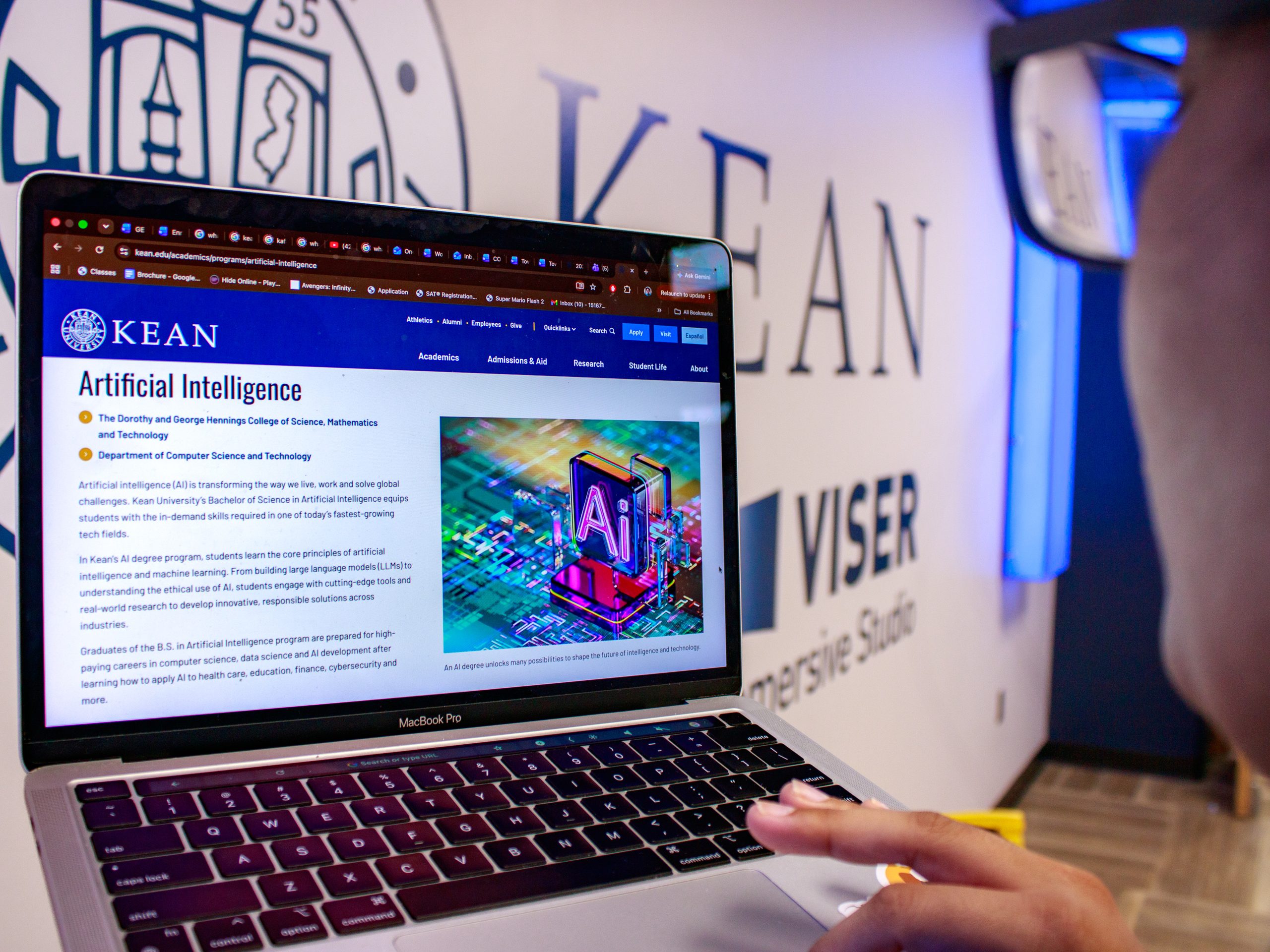
Artificial Intelligence is shaping the future of technology, and at Kean University, students can now major in it. Beginning in Fall 2025, Kean University students have the option to receive a Bachelor of Science in Artificial Intelligence (AI). Kean is the first college and university in New Jersey to offer this to its students.
In addition to a B.S. option, students can participate in a five-year program to receive a Master of Science in Computer Science as well as a bachelor’s.

Kean students working toward an AI degree will learn how to create large language models, explore the core principles of AI, consider the ethical implications of AI, and collaborate in teams to apply AI technology to cybersecurity, education, software engineering, and health care.
Kean was able to earn the title of first collegiate institution to offer an AI major credited to President Lamont O. Repollet who prioritized the program as part of Elevate 2030, a five-year plan to improve the university in regard to equity, innovation, and research.
Since Kean launched the AI major, Stevens Institute of Technology has followed suit in offering their own B.S. in AI program beginning Fall 2026. Other NJ colleges like Rutgers, NJIT, and Rowan allow students to have a concentration in AI but don’t offer it as a standalone major.
Emmanuel Babayemi, a senior at Kean, was previously a computer science major but instead decided to pursue an B.S. in AI with a cybersecurity minor. Post-graduation, Babayemi hopes to incorporate his AI degree to pursue a software engineering role.
What drew Babayemi to the AI major is the “novelty in being trained on AI skills ahead of the time for career prospects,” he said.
The growing use of AI is expected to create more opportunities for individuals in technology-related fields. According to the U.S. Bureau of Labor Statistics, the inclusion of AI in the use of information technology is projected to increase jobs for workers over the next decade, in areas like data science (33.5%), information security analysis (28.5%), and software development (15.8%).
Similar to Babayemi, junior Marvin Ayala is studying AI after previously majoring in computer science. Ayala is curious to learn about AI but acknowledges some hesitations with the technology.
“I’m concerned about how quickly these systems are advancing compared to our ability to understand their behavior, limitations, and potential misuse,” Ayala said.
Consequently, Ayala plans to use his B.S. in AI to work in AI safety research with a tie into software engineering and data.

Yulia Kumar, a professor in the Department of Computer Science and Technology at Kean, encourages students interested in AI to consider taking advantage of the program.
“It is obvious that AI is changing the world and job opportunities,” Kumar said. She encourages students who are open to experimenting to consider the major and the opportunity to be among Kean’s first AI graduates.
In order to receive the B.S. in AI, students must total 120 credits as outlined in Kean undergraduate catalog. Course requirements span from the technical aspects of AI to the ethical implications of the technology. The program provides students with the opportunity to explore AI in an academic setting and how it can be applied to a variety of careers.
In the United States, there are 208 bachelor’s degree AI programs offered at universities and colleges across the country. Evidently, interest in the AI field is rapidly growing, and academia is adapting as a result.
The introduction of the AI major program is the focal point as Kean expands its academics regarding technology-related offerings. Kean has also introduced new minors such as bioinformatics, computer science education, cybersecurity, and information technology for students to explore and diversify their knowledge in the technology world.
You must be logged in to post a comment.