By: Professor Will Heyniger | Publish Date: February 26th, 2026
Food. For most of us, it’s a one-way street: We eat it. Simple enough, right? However, there’s more to the story of food once it passes by our mouths and eyes. Some of it, rightfully, is returned to the refrigerator for leftovers, a great way to recapture its value. Yet some of our leftovers get tossed into the garbage, as we wait for it to ‘go away somewhere else’—and that’s the issue.

Food scraps, uneaten food, and expired food can be redirected for a beneficial use: as compost. Compost, technically called a ‘soil amendment’, is the natural reclamation of food after it has been broken down into smaller bits by microbes. Microbes, the tiniest of creatures, breathe oxygen and do some heavy lifting by basically eating our leftover waste. According to the U.S. Composting Council, compost is “the product… (which has) undergone mesophilic and thermophilic temperatures (meaning different types of microbes function at different temperatures) …such that it is beneficial to plant growth.” Composting is a way to return energy that was taken up by the plant to grow food back into the soil—and it works!
That waste volume can be quite large. According to the New Jersey Department of Environmental Protection, a person generates 3.5 pounds of food waste/scraps per week, costing Americans 218 billion (yes, billion) dollars worth of food each year. It costs a staggering amount of energy to plant, grow, harvest, package, and transport these wastes. It also contributes to climate change, since rotting food ends up in a no-oxygen environment, commonly known as landfilling (where all waste is piled up and capped with soil, eliminating interaction with oxygen) or is incinerated (burned).
Kean University is no different. We are a small community of over 10,000 students (not all of whom eat on campus) that throw out food. Some extra food piles on our plates (our eyes are too big) or some parts of food just can’t be eaten by humans (think bones, thick stems or personal preference). However, Kean has had a solution for the last 15 years to reclaim our food waste by composting.

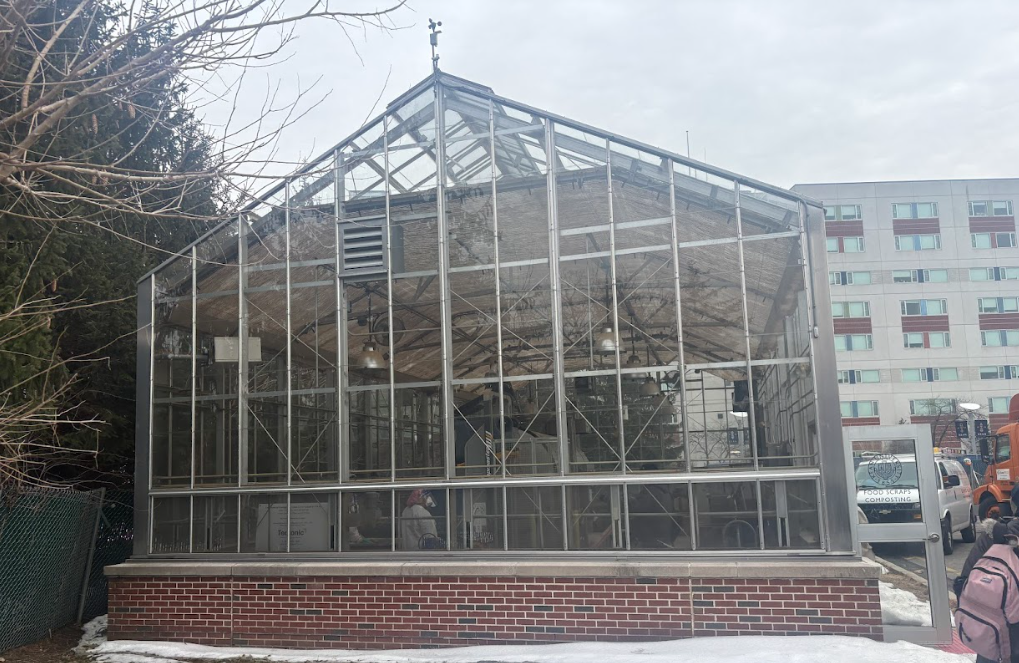
Behind the Miron Student Center sits a glass greenhouse housing the Kean University Composting Laboratory. Inside, student workers unload Kean’s leftover food and locally sourced wood shavings (part of the chemical mixture required for proper composting) into a machine resembling a large silver pipe. Lids are closed and the internal pile is oxygenated every 10 minutes, so the microbes present naturally in our food wake up and do what they are best at…EATING! This six-by-nine-foot vessel accepts up to 1,000 pounds of food and 300 pounds of wood shavings per day to redirect Kean’s food waste stream away from incineration. This then reduces air pollution while promoting healthier soil on campus.
This technique is different from traditional outdoor composting, which requires up to 12 months in New Jersey to be deemed fully mature compost—unlike Kean’s system, which completes the process in just five days. All composting requires oxygen, and Kean’s technology is no different. A pump keeps the microbe critters happy by injecting fresh air through the vessel every 10 minutes. The system also rotates itself once an hour, similar to your stomach muscles, and offloads the compost into a trailer to be used around campus.

Composting Kean’s food has been a success, diverting over 725,000 pounds of food and 180,000 pounds of wood shavings. Although not a direct replacement for soil, this naturally regenerated soil amendment can be used just like it. The energy in food compost rejuvenates the energy soil lost to grow a plant; it’s no different from you needing a nutritional recharge after depleting your food energy. Studies have found that compost usage leads to better plant growth, plant mass (healthier plants grow bigger), and larger harvests per plant while requiring less watering. Some studies, such as one by Suvendran et al., indicate up to 50% less water needed per plant after integrating (and annually upkeeping) two to four inches of compost into the soil profile. These results all make sense, since healthy soil and nutritionally energized plants can fend off droughts, heat, insects, and diseases more effectively than stressed plants not utilizing food-based compost.
Food composting is a solid solution to the multi-pronged challenges facing our planet and survival. Landfilling and incineration of food waste/scraps generate powerful greenhouse gases (from both landfilling and burning) and leachate (polluted liquid seeping from landfills). This requires large tracts of land and creates a myriad of issues for residents both near and far from these terminal graveyards for food waste. Unlike the composting lab, these are neither sustainable nor long-term.
Kean is leading the world in innovative technology, student skillset development, and sustainable directives with the food composting laboratory. So stop on by the composting lab the next time you’re near the volleyball courts to experience how Kean Cougars Climb Higher!
You must be logged in to post a comment.