By: Hajar Lababidi I Published: December 2, 2025
It has been half a year since New Jersey City University (NJCU) agreed to merge with Kean University, a move that will reshape the landscape of public higher education in New Jersey. The integration, expected to be completed by July 2026, represents the first merger of two public anchor institutions in the state’s history.
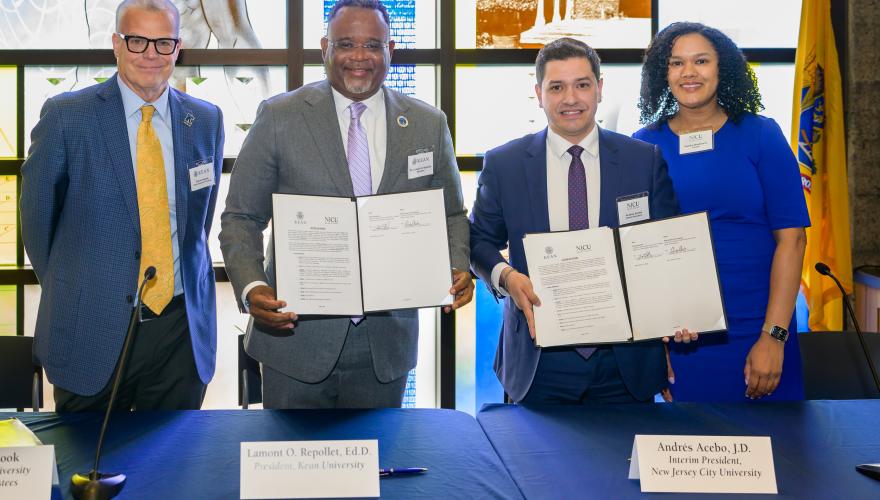
Following a Letter of Intent in May and a definitive agreement in October, the two institutions convened on October 8th for their first joint town hall to address questions from students, faculty, and staff.

NJCU President Andrés Acebo opened with a sweeping reflection on the merger as “sacred work” driven by the universities’ commitment to the populations they serve. Echoing this sentiment, Kean President Lamont Repollet framed the merger as a climb toward equity, opportunity, and innovation. Both leaders stressed that the merger is about empowering students from urban communities and preserving NJCU’s legacy as it enters its second century.
NJCU, long a vital institution for Jersey City’s working class and immigrant communities, faced financial instability that threatened its future. Kean, meanwhile, has been on a trajectory of growth in recent years, leading to a more extensive faculty, achieving higher research output, and the strengthening of student success initiatives. The two presidents emphasized viewing the merger as not simply administrative, but a move to preserve access to higher education for urban students that might otherwise lose a critical pathway.
Repollet described his turning point during a campus visit, saying, “I saw myself in those students… growing up in urban communities, sometimes individuals feel forgotten. So I said to myself, who’s going to be their champion? That’s why we did it.”
A form that was sent out prior to the Town Hall to students and staff of the two universities allowed them to submit questions regarding the process. In addition, live questions from the audience were addressed in the hour-long discussion.
Questions about campus identity were met with assurances that culture will be nurtured, not imposed. Repollet highlighted Kean’s “culture of care” and new integration teams designed to bridge traditions. Acebo added that the merger offers a chance to build a university that reflects the communities it serves, citing NJCU’s initiatives in equity-driven student development.

Repollet clarified that departments will not operate separately, but under unified leadership to avoid duplication of services. Faculty and staff were urged to participate in advisory committees, surveys, and town halls to shape the transition.
“It’s time to advocate for yourself,” Repollet said, underscoring the importance of stakeholder input.
Acebo described the merger’s “North Star” as enhancing academic opportunities by combining NJCU’s distinctive programs with Kean’s growing research profile. Repollet emphasized student support, citing Kean’s success in retention through initiatives like Cougar Connection and Moonshot for Equity. He pledged that these best practices would extend to Kean Jersey City students.
Responding to students’ concerns about program requirements, diplomas, and services, leadership explained that academic reviews are underway, with scholarships guaranteed and diplomas dependent on graduation timing. Services such as advising and athletics will be unified, with committees exploring options for Greek life, housing, and extracurriculars. Advisors from both campuses are already collaborating to ensure continuity.
Repollet acknowledged that layoffs are likely as part of the restructuring process, but promised fairness, transparency, and respect. He emphasized that decisions would prioritize sustainability and student success, with unions involved in negotiations. As he put it, “rainbows only happen after storms.”
The coming months, if all goes well, will continue to showcase a spirit of collaboration and transparency for both populations—to truly arrive at the rainbow after the storm.
You must be logged in to post a comment.