By: Nick Hathaway, Hajar Lababidi, and Kevin Modeszto I Published: January 22, 2026
Disability activism in America dates back to 1960, when advocates joined forces with other minority groups to demand equal treatment and access for people with disabilities. This movement brought about significant changes in the law protecting the civil rights of Americans with disabilities, from education to employment.
The most impactful of these was the Americans with Disabilities Act (ADA) passed in 1990, which provides assurance of “reasonable accommodation” for Americans with disabilities. Maxwell Burkey, a professor at Kean who teaches Political Science courses on democracy and citizenship, described the legacy of the disability rights movement of the 20th century and beyond.
“One result of the struggle for disability rights has been the development of a network of political action and community support that is not reliant on mainstream institutions,” he said. That network “exists to pressure those institutions into upholding obligations to disabled Americans.”
According to Dr. Burkey, this reflects many other efforts for disability rights today. “Students with disabilities engage civically and politically with the existing networks of support and advocacy,” he said. This includes The Arc and the American Association of People with Disabilities (AAPD), two non-profit institutions dedicated to helping Americans tackle ableism in all its forms.

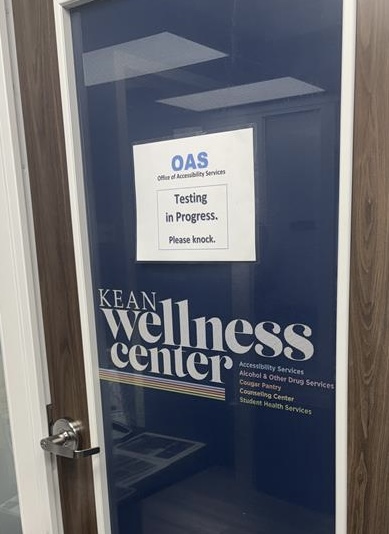
At Kean University, the Office of Accessibility Services was established to address the needs of students with accessibility needs. Accessibility is the effort to make physical and digital spaces usable for everyone, regardless of ability. This translates to a variety of services—from ASL speech interpreters to wheelchair-friendly buildings.
The office requires students to “self-disclose their disability and submit current documentation to verify eligibility as defined under applicable law.” For a public university like Kean, this can extend to accommodations like extra time on tests and assignments.
Generally, students who need accommodations are supported by their professors.
Sophomore Zenola Bristol has major depression and anxiety, which can cause her to completely shut down. As such, she receives extra time on tests and additional excused absences.
“My accommodations are met, and I can’t believe that [any professor] would not meet [them],” she said.
Similarly, junior Michael Matthews, a Kean Ocean student, cited his experience as “mostly supportive” for his accommodations.
“I have never had a professor not know what they’re doing with accommodations,” he said.
On the other hand, there have been some cases of professors not honoring accommodations, as in the case of Andre Foster. In the spring of 2025, Foster, who was a junior at the time, entered his class for a midterm. Foster is visually impaired and receives accommodations that allow him to take exams in the Testing Center.

For his midterm, however, the professor did not allow him to go to the Center. To make up for it, he brought Foster out into the hallway and provided him with the list of exam questions to memorize—the font much smaller than he needed to be able to read them.
“My eyes were continually strained,” he recalled. “I don’t know if it was just negligence on his part, maybe not knowing, or maybe he didn’t care… but it definitely affected me.”
The same scenario played out during finals week, and as a result, Foster couldn’t complete either exam.
Foster, 31, is a Liberal Arts major and Communications minor who transferred to Kean University from Middlesex College for the 2024-2025 school year. In obtaining his accommodations, Foster credited the Office of Accessibility. “They go out of their way to meet the needs of their students to the best of their ability,” he said.
The encounter, and others like it, reminded him of the reality for many disabled students.
“Just because some of us may have different abilities, doesn’t mean that we shouldn’t be offered the same education as everybody else,” he said. “We’re all striving towards the same goal.”
This is not the only time Foster has had to grapple with professors to maintain basic accommodations. At one point, the struggle to maintain his accommodations led to Foster having to drop his class.

The issue with one professor escalated so much that Foster had no choice but to report it to the Office of Affirmative Action, who then warned the professor that they were required to follow the Americans with Disabilities Act (ADA).
Student leaders have been taking the initiative to help improve campus life for disabled students. One such student, sophomore Kenzey Meiz, has recently reinstated the NeuroAllies Club, an organization for neurodivergent and disabled students.
“From my own experience working with kids with autism and learning disabilities, I know how important the right support is,” Meiz said.
She claimed that the process of getting documentation can be problematic, placing undue burden on the student for accommodations for everything. In addition, the general attendance policy of “attendance is expected in all courses,” which she says can lead students to have to fight for flexibility on a case-by-case basis.
When pressed for comment, the Office of Accessibility declined to speak with The Tower at this time.
Tower reporters discussed the issue with faculty members at Kean, who framed the issue as being, ironically, one of accessibility. Several highlighted the lack of awareness among students on what accommodations were available to them.
This may be in part due to a limited number of staff. The Office of Accessibility at Kean only has four employees. New Jersey City University, a university with less than a third of a student population, has six.
Nicole Francisco, the Associate Vice President for Media Relations, explained the role of accessibility at Kean University.

“OAS serves as a conduit between students and faculty, coordinating reasonable accommodations while emphasizing personalized, individualized support,” Francisco stated. “OAS conducts regular student check-ins multiple times a month and end-of-semester surveys to assess services and identify improvements.”
To improve experiences for students with accommodations, Bristol suggested monthly training for professors. Similarly, Meiz claimed that the process would be greatly improved if Kean, as she phrased it, “put the rules in writing, train faculty annually, and make timelines and escalation paths public.”
Foster viewed more options for students, such as having a designated notetaker during lectures and usage of a special accessibility keyboard for people with low vision, would go a long way towards helping students with disabilities have their needs met and voices heard. He also suggested a space for special needs students to gather and share their needs, which is in line with what NeuroAllies intends to do.
“[When the club is reinstated], we’ll be doing workshops, outreach, and giving students a real platform to push for change,” Meiz said.
According to Francisco, the OAS has “plans to expand in the future to continue meeting student needs.” In addition, “the office has established a grievance and feedback process for accessibility-related concerns,” available here.
You must be logged in to post a comment.