By: Hajar Lababidi | Publish Date: October 29, 2026
Phishing is a common scam tactic where scammers send fake messages, through email, texting, or other methods, pretending to be from a legitimate organization. The goal is usually to obtain sensitive information such as log-in passwords and credit card numbers from targeted individuals and often include third-party, unencrypted links that, if clicked, can put a device at risk of hacking.

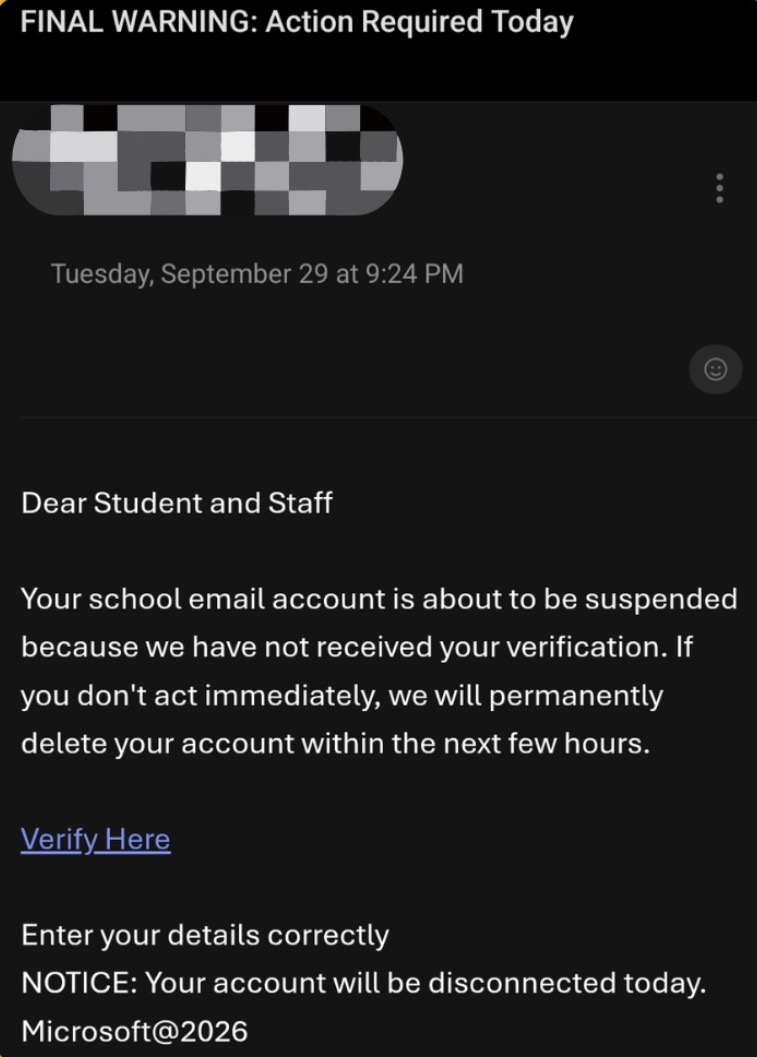
At Kean University, such tactics are not rare; acquiring student information such as Kean emails or Canvas access can be valuable for scammers and dangerous for students who fall victim to such attacks. These messages usually are vague in attribution and can contain either alarming information, such as “your account will be shut down if you do not take action today,” or tempting offers like giveaways and hiring positions with unreasonably high salaries.
“Aside from the recent obvious one at Kean, there’s definitely been a general awareness of this type of scam,” said Cassandra Kossowsky, a junior majoring in English Writing. “You get taught in computer classes to not click on strange links and don’t give random people your bank information.”
But these messages can often be too tempting to ignore. Kossowsky herself, despite her training, has fallen victim to one such incident of phishing.
“It was obvious enough what it was that I couldn’t even call it amateur,” she recalled. “It was sent from a student email claiming to be staff. It gave no information on what it was talking about. It was short, rough, and just obviously illegitimate.”
At first Kossowsky ignored the message.
“But it was such a bad attempt, and I was curious, so I clicked the link,” she admitted. “I figured that someone so bad at make a scam email wouldn’t know how to bug a link.”
The link then took her to a Google form asking for her phone number, Kean email and password, and even the email and password of previous schools she had attended. It was at that point that she knew not to pay attention to the message any longer, and she closed the form.

However, even the mere act of clicking a link in a suspicious email or text can be dangerous. Phishing schemes often use a tactic called spoofing, where they change the website URL in a message to appear legitimate or familiar. This link can be unencrypted, meaning a victim’s IP address and even location may be trackable, or malware can be downloaded on their device. This can then expose sensitive information to hackers and scammers.
The Kean Office of Information Technology, formerly the Office of Computer and Information Services, has sent multiple messages to the student body about these schemes. On its Instagram page and through mass emails, the office has provided information on what to do to shield oneself from these attacks.
“Awareness of scam attempts like this is part of why I wasn’t scared by it,” Kossowsky said. “People recognizing phishing is probably why the email disappeared not long after I saw it in the first place. People saw it for what it was and reported it, which ultimately keeps people safe if they don’t actually know to not be scared by it.”
Fellow Kean student Kimora Givens, a senior studying Graphic Design, has also had a negative experience with phishing. At her internship, she described receiving a scam email advertising job offers and events in an effort to get her to share information about herself and the company.
“To raise awareness, the company sent a simulated phishing email offering a chance to get a free ticket to New York Fashion Week,” she said. “When someone clicked the link, a page revealed that it was a phishing awareness exercise and explained how to recognize suspicious emails.”
Givens has since learned to check an email carefully before clicking any links.

“I learned that even if an email looks convincing and uses familiar branding, like Kean’s, that doesn’t necessarily mean it’s legitimate,” she said.
Tell-tale signs of a phishing attack include generic greetings (such as “Dear Student/Staff” or “Dear Sir/Madam”), an email address that is not official, random attachments, and buttons with hyperlinks to unfamiliar websites.
It’s important to verify the true URL, which can be made to display as something different in the email. This can be done by hovering over the link or copying it and pasting it in the search bar without pressing enter.
If a student does click on a link or sends sensitive information to scammers, Kean IT recommends changing their Kean password immediately at https://www.kean.edu/password and contacting the Kean IT Help Desk at 908-737-6000 for further assistance in securing their account.
With phishing tactics appearing more frequently in an increasingly digital world, the ability to defend against such threats will help students be protected during their academic years and throughout their careers.
You must be logged in to post a comment.