By: Kevin Modeszto | Publish Date: November 15, 2026
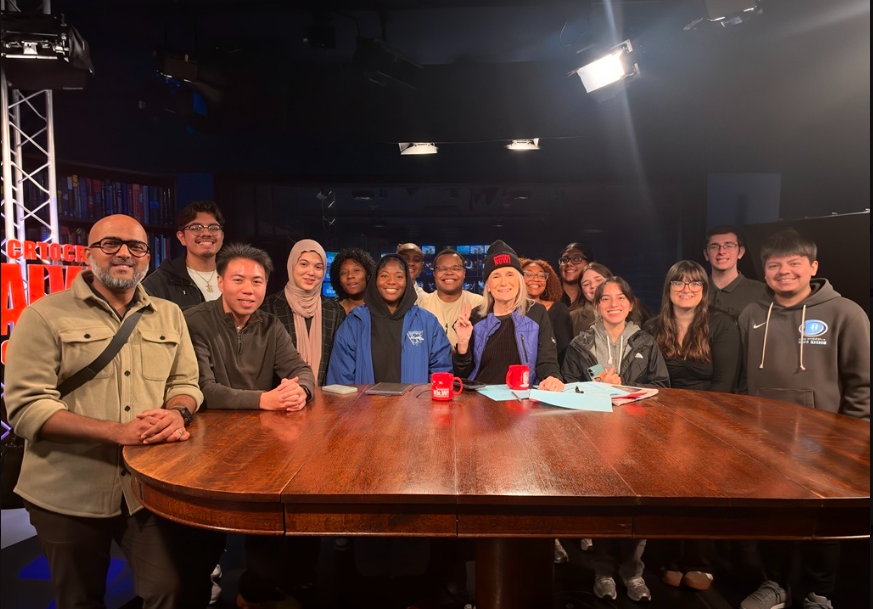
On Friday, November 13, seven Tower reporters (six fulltime, one volunteer) toured Democracy Now Studios in Manhattan, New York City. We witnessed a live broadcast of the show, had a Q&A with both host Amy Goodman and guest Dr. Feroze Sidhwa, and were given a tour of the studios as well as a media literacy session by Education Manager Carlos Pareja.

Democracy Now! is an independent news broadcast that began in 1996. In the show, Goodman reviews global headlines along with deeper analysis on certain issues featuring expert interviews. In the show we witnessed, these topics were the resignation of Nvidia CEO Jensen Heung, the death of an infant in Gaza through hypothermia, and the Rule of Law project.
“It means so much to have a group of student journalists visit, because you’re the future,” Goodman said when prompted on what the trip meant to her.
For The Tower’s editor-in-chief Kevin Modeszto, this was a glimpse into a brand-new newsroom. Entering the trip, Modeszto knew next to nothing about Democracy Now.
“I was in awe and inspired by how much I learned from and enjoyed watching the show,” Modeszto said. “I learned a lot about AI, Gaza, government accountability, and gained more insight on the topics that Goodman mentioned in her headlines.”
While Modeszto enjoyed the entire trip, his self-described “incredible experience” was highlighted by the kindness of everyone he met at Democracy Now.
Goodman’s natural talent stood out to Managing Editor Susan Berube-Leiva. Watching Goodman use her phone during the broadcast made the experience seem more down-to-earth and achievable to her.

Modeszto, Berube-Leiva, and News Editor Hajar Lababidi spoke highly of one of the guest interviews. Dr. Feroze Sidhwa, who has done medical work in Gaza, moved both of them. For Modeszto, it was when Sidhwa explained how dangerously sick the region had become.
“Meeting Dr. Sidhwa was…one of the most impactful moments of the visit,” Lababidi said. “Through his brief time with us, first on the show and then taking questions, I learned so much, gaining exposure to new perspectives. I remember my mind going haywire with all of these new questions I had from the talk.”
Berube-Leiva also spoke highly about Sidhwa and his knowledge. Seeing Sidhwa recognize patterns, reporting on differences, and interest in preventing the world from repeating mistakes stuck out to her.
“Like many others, the talk with Dr. Sidhwa really stood out to me. In part because of his distinct position in the Israel-Palestinian “conflict” (genocide), but also because of how well versed he was in history,” Berube-Leiva said. “He was able to provide the names of people in power, the historical background of the conflict, and he said it with such confidence that you could really tell he studied these things.”
Both the journalists and Sidhwa enjoyed the experience. Sidhwa had never seen a group of student journalists in a live audience before, and found seeing a group of young journalists interested in both the field and the world amazing.
Additionally, Lababidi gained insight on how journalism can be used as a form of activism.

“I learned what journalism can look like as a form of activism. The advice I received was down-to-earth, realistic, and extremely helpful for my goals and interests,” Lababidi said, “I leave Democracy Now with a new outlook on my career: journalism, not in opposition to advocacy, but a facet of it.”
Sports Editor Denny Quinteros also gained a new insight: The importance of international journalism.
“Even though sports communication is my primary interest, it was helpful for me to consider international journalism and problems that concern the entire world,” Quinteros said. “My native country, El Salvador, is something special for me.”
The editorial team unanimously agreed that they gained greater insight of the knowledge journalism requires. For Quinteros, this was seeing a live news production. For Modeszto and Lababidi, it was the physical materials in the newsroom. Modeszto highlighted the archival process while Lababidi was in awe of Democracy Now’s collection of books and the vital information inside it. For Berube-Leiva, this trip solidified the importance of independent and objective journalism.
“I consider myself to be very democratic and so growing up when my father explained to me that there were people who could label themselves as independent, I was a little confused and wanted them to take a side – my side specifically,” Berube-Leiva said. “However, after being introduced to Amy Goodman and her reporting, broadcasting, and humanitarian work, I am very inspired by her and now see things in a different light. I think her independency is what makes her genuine, because there is no corporation that is telling her what to report on and what not to.”
You must be logged in to post a comment.