By: Hajar Lababidi | Publish Date: April 25th, 2026
There are certain elements to living here in New Jersey—the sound of trucks early in the morning, the intoxicating scent of smoke in the city—that always brings me back to my brief life in urban Syria (a country in the Middle East, bordering the Mediterranean), nearly fourteen years ago. I slip back in time in those moments, to a place thousands of miles away. In the years I grew up as an American, I viewed that life as increasingly remote, unreachable. In our ever-changing world, I begin to feel that changing.

For nearly fourteen years, from March 2011 to December 2024, the country of Syria had been embroiled in a civil war. Watching safely from America as the years wreaked havoc on our father’s homeland, my siblings and I never imagined an end to the war. It seemed that the destructive Assad regime would always be in power, that our relatives would always be scattered like seeds on a wind, that the fighting would wear down the nation until it was impossible to return to what it was before.
Incredibly, though, the war drew to a close nearly a year and a half ago. In early December of 2024, over the span of a mere eleven days, rebel forces led by Ahmed al-Sharaa (known as Abu Muhammad al-Jolani at the time) overtook the capital of Damascus and overwhelmed Assad’s forces. The dictator fled to his ally Vladimir Putin in Russia for sanctuary, seeking asylum for himself after having caused the largest refugee crisis in the world.
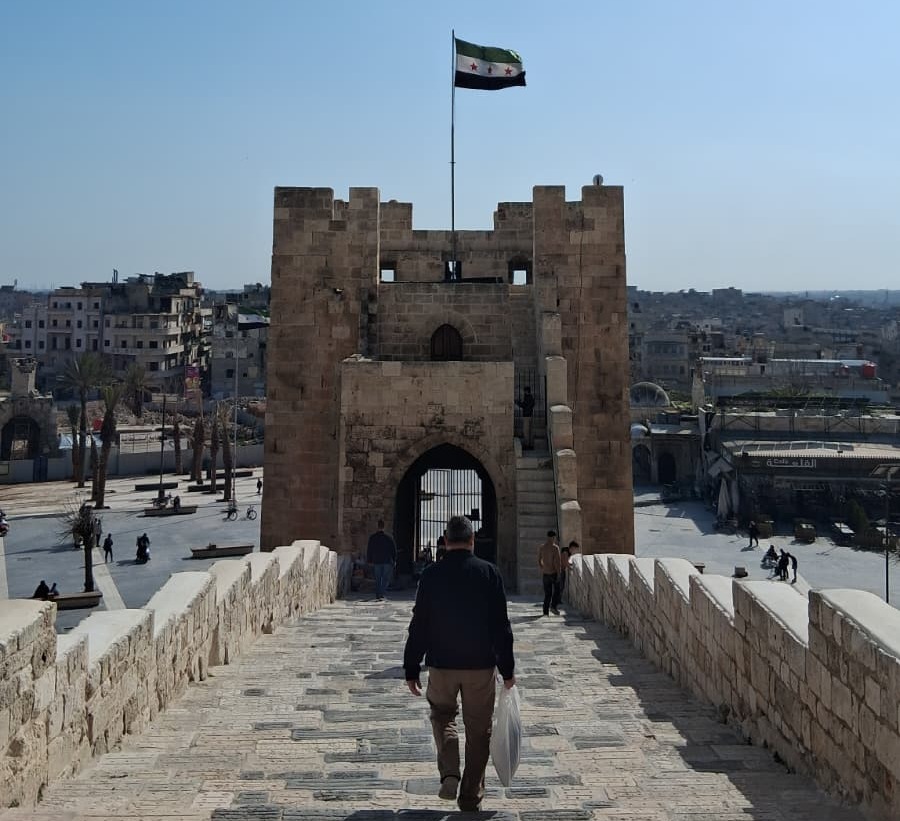
I think Syria has become a real place to me now, brought to life by tales told by my brothers and father, who recently visited the country. The photos my brother, Hamza Lababidi, brought back, along with little toys, sweet treats, and elaborate clothing, solidify what we have known for many months now, but what never quite felt real until now: that the one-party rule over Syria was over.
Below are a few of the snapshots of the reality of the country in its two most prominent cities. Scarred yet hopeful, it is a nation emerging as if from a deep, restless, painful sleep, to a future uncertain, still rocked by conflict but with a path ahead, for all Syrians. They are predominantly from Shaam (Damascus), the capital of Syria, and Halab (Aleppo), one of the most ancient cities in the world.


Syria is a world at once alike and different from our own. The photos my family brought back aren’t entirely representative of the country’s rich history and diverse people. It’s an ancient society, a multiethnic nation, built up by Muslims, Christians, Druz, Arabs, Armenians, Assyrians, Kurds, and countless other peoples.
Yet one can glean a message through the small bits of memories contained within photos. It speaks of hope. It speaks of scars. It speaks of joy. It speaks of resilience. It speaks of a people long worn down by war, uncertain of the future but finally able to freely breathe again.
You must be logged in to post a comment.