By: Cimmiaron Alvarez, PhD
In college, professors, group project members, and collegiate staff expect students to communicate with them in a professional manner. In this article, I am going to explain how you might use face and facework to create a performance of professionalism. Of note, although this is written by a professor, each instructor has their own interpretations of professionalism. I offer these recommendations based on my own views on professionalism. In other words, these recommendations are general suggestions, not rules of law, that I think are the most fundamental for a first-year college student.
Intro to Face

First, Face is the performance an individual puts on based on their identities and the context that they are in. For example, how you perform the identity of student is different depending on if you are out with friends on a Friday night or in the classroom with your professor.
When you are out with friends you are probably more talkative, outgoing, and emphasize a variety of aspects of your personality. Yet, when you are in class, you might be more focused on the professor’s words, engage in only topic related discussions, and emphasize your knowledge of and desire to learn the material.
Regardless of the context, individuals have a positive face, a desire to be accepted and well-liked by others, and a negative face, a desire to be free from imposition.
Although both types of face are important, professionalism focuses on positive face. Through professionalism, you are working to portray yourself as a competent, respectful, and accountable individual.
There are a variety of ways that you might portray yourself professionally. The list that I provide here is a mere fraction of professional behavior; however, I argue that these are the basic professional behaviors that your professors, peers, and eventual employers will expect.
Tips for Professionalism
First, show up on time: Whether it is class, a meeting with your professor, or a club meeting, you should be on time. I recommend relying on the adage “early is on time, on time is late and late is unacceptable”. When you are on time, it shows that you respect others’ time and commitment and that you are conscientious.
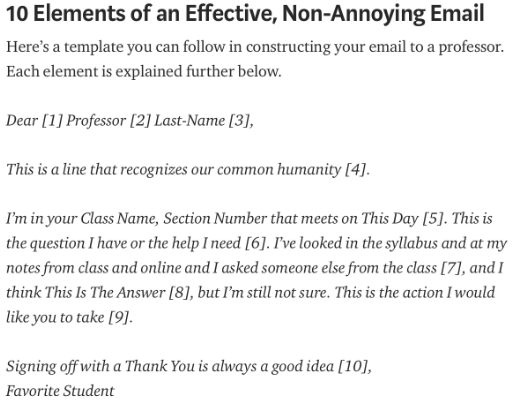
Second, when writing an email, regardless of who you are writing to, you should always greet the recipient, for example “Hello Dr. Alvarez.” Before emailing a professor, take a moment to recognize how your professor introduces themselves; that is how you should refer to them.
Personally, I introduce myself as Dr. Alvarez and I am perfectly happy when students refer to me as Professor Alvarez. Both titles emphasize the decade that I spent becoming an expert in my field. Regardless of how a professor would like you to refer to them, they will tell you in class, in how they refer to themselves, and in how they sign their own emails to you.

In the body of the email, write in complete sentences with proper capitalization and punctuation (save texting style for text messages with friends). I also encourage you to write emails in a kind and respectful manner. When ending your email, use a complementary close followed by your name, for example “Sincerely.” These recommendations stand for whether you are using email or messaging through Canvas.
Third, make sure you read all of the materials the professor provides for you, such as the course syllabus, the assignment descriptions, and the rubrics. Your instructors spent a lot of time crafting these documents to help you understand the class, assignments, and answer general questions, like when is the assignment due. That is not to say that your professors do not want to answer your questions, but they do not want to answer questions that they have already provided the answers to.
Instead, read these materials, know the information, and then ask the specific questions that you have about your approach to the assignment. In these instances, your professor can actually help you improve your work and learn, rather than just repeating information that they have already outlined.
Regarding a course syllabus specifically, saying “I did not know” about information and policies that the professor provided in the syllabus is an unprofessional response to your professor’s policies. They provided you with a syllabus, or a written agreement, about what they would expect from you and what you could expect from them throughout the semester. Professors are not trying to trick you; they want you to know what to expect in their course, that is why they put in in writing.
Finally, turn in materials on time. As a professor, I have found that students expect that there is a late policy and that I will accept their work, with a minor reduction. Although this might be something that students experience in high school and maybe college, workplaces expect that you are professional, or reliable, enough to complete deliverables on time.
The way that you develop this skill is by viewing deadlines as meaningful now, during college. Once you get into the habit of understanding that deadlines are final, you can start meeting them with regularity. As such, I recommend that you view your course deadlines as the last moment to submit your assignments. If you get into this habit now, you will be more prepared for the level of professionalism that will be expected of you in the workplace.
Again, these are just a few recommendations for professionalism. Professionalism goes beyond these four recommendations, but these are the most basic elements you should understand when starting college.
You must be logged in to post a comment.