By: Michael Kurtz | Publish Date: March 30th, 2026
The 2026 Major League Baseball season is here, and while Opening Day brings renewed focus to the stars already on big-league rosters, every organization knows the long-term success of a franchise depends on what’s coming next. Across the league, front offices spend countless hours scouting, developing, and evaluating the talent rising through their farm systems; players who could soon become the next faces of their franchises.
Spring training is not just about preparing veterans for a 162-game grind; it’s also a window into the future. Top prospects arrive in big-league camps looking to make an impression, whether that means competing for a roster spot or simply showing they’re one step closer to the majors. For fans and executives alike, the development pipeline is just as important as the present-day roster.
With that in mind, let’s take a closer look at the top prospect for every Major League Baseball team heading into the 2026 season. This article will cover the 15 teams in the American League, including our very own New York Yankees. Later today, we will publish the other half of this article, covering the National League.
AL East
Baltimore Orioles: C/1B Samuel Basallo: The Orioles poached Basallo from their division rival, the Yankees, for $1.3 million in January 2021. He quickly turned into a fantastic investment, hitting 20 home runs and a .953 OPS in Double-A. He then followed that up with 19 homers and reached Triple-A. Basallo made his MLB debut late in 2025 and did not disappoint. He consistently barrels up the ball (90th percentile in average exit velo at 108.2 mph via Baseball Savant) to add to his raw power. Currently ranked as the Orioles’ No. 1 prospect, Basallo is best known for his bat, but he can make noise behind the plate. He threw out 38% of base stealers at the major league level, and continues to make progress defensively.
Boston Red Sox: LHP Connelly Early: Early has developed into a true fastball-oriented pitcher, steadily increasing his velocity at every level of professional baseball. That added velocity helped the 2023 5th round selection surge through the minors and eventually earn five starts for the Red Sox in 2025, including a do-or-die Game 3 appearance in the Wild Card Round. Currently ranked as the Red Sox’s No. 3 prospect, Early features depth, run, and movement across his entire arsenal, aided by a lower arm slot for a left-hander that creates difficult angles for hitters. His fastball now sits in the 92–95 mph range, a notable jump from the roughly 90 mph he showed earlier in the minors. He complements it with an 84-mph changeup that is particularly effective at neutralizing right-handed hitters. With his improved stuff, ability to consistently throw strikes, and competitive tenacity, Early has quickly risen to the major leagues and projects as a solid No. 3 starter, with the potential to develop into No. 2 from the left side.

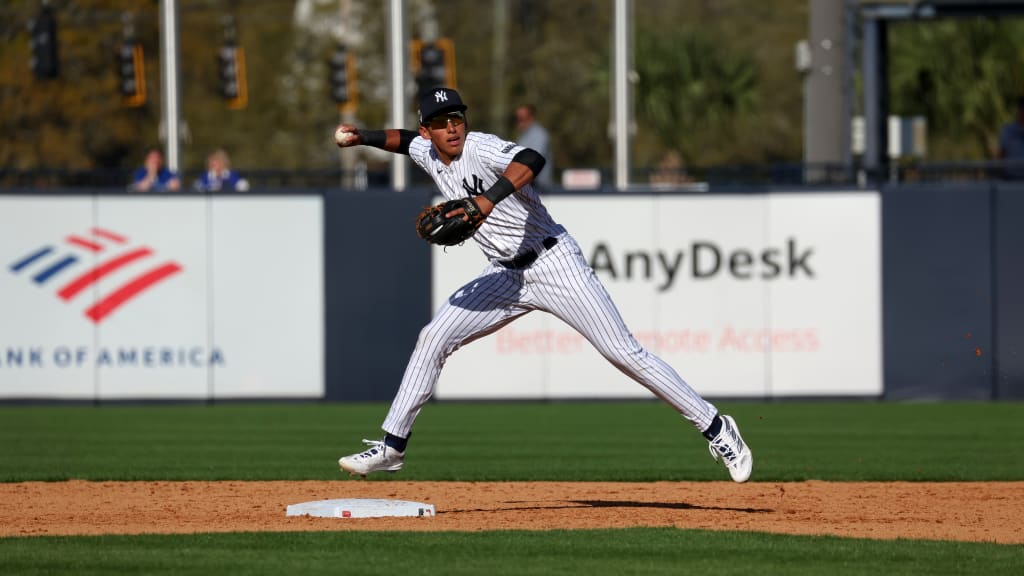
New York Yankees: INF George Lombard Jr. Lombard Jr. is the textbook definition of a high-IQ player. Drafted 26th overall by the Yankees out of Gulliver Prep HS in 2023, he quickly rose to become one of the top prospects in baseball. Unlike other recent Yankees shortstop draftees, such as Anthony Volpe in 2019, Trey Sweeney in 2021, and Dax Kilby in 2025, Lombard Jr. offers a more polished blend of offensive production and defensive reliability. His rapid development pushed him to Double-A Somerset at just 19 years old. He struggled initially, slashing .215/.337/.358 in the Eastern League. But with above-average power, speed, and elite defensive range, Lombard has the tools to develop into a 25–25 threat who can stick at shortstop for New York if Volpe falters. Ranked the Yankees’ No. 1 prospect, Lombard combines bat speed, on-base ability, power for the position, and strong defensive instincts, along with a baseball pedigree as the son of Tigers first base coach George Lombard Sr., giving him the potential to become one of the game’s premier shortstops.
Tampa Bay Rays: SS Carson Williams: Drafted 28th overall out of Torrey Pines High School, Williams quickly emerged as a power-speed threat in the Rays’ system, posting three consecutive 20/20 (20 home runs and 20 stolen bases) seasons. In 2025 at Triple-A, he hit .213/.318/.447 with 23 home runs and 22 stolen bases before getting a brief call-up to the majors later that year. Defensively, Williams stands out with a quick, strong, and consistent plus arm at shortstop. Offensively, his strong exit velocities and power-speed combination give him the potential to remain a reliable 20/20 contributor. The main question is his hit tool, as swing-and-miss issues, including a 41.5 percent strikeout rate during his MLB stint, remain a concern. Ranked as Tampa Bay’s No. 1 prospect, Williams could provide the Rays with the long-term answer at shortstop they’ve been searching for.
Toronto Blue Jays: RHP Trey Yesavage: Drafted 20th overall out of East Carolina in 2024, Yesavage quickly rose through the Blue Jays’ system and became a key contributor during Toronto’s 2025 World Series run. His rapid ascent has been driven by a plus fastball and an elite splitter. With an over-the-top delivery, his four-seam fastball generates roughly 20 inches of ride, while his splitter features a sharp top-to-bottom drop that consistently misses bats. Yesavage gained national attention during the 2025 postseason, throwing 5⅓ no-hit innings with 11 strikeouts against the Yankees in the ALDS and adding 12 strikeouts against the Dodgers in the World Series. Entering his second full season, the Blue Jays’ No. 1 prospect is expected to remain a key piece of Toronto’s rotation. Whether his three-pitch mix can continue to generate swings and misses at the highest level will determine if he develops into a No. 2 starter, an ace, or simply settles in as a strong mid-rotation arm.
AL Central
Chicago White Sox: OF Braden Montgomery: The switch-hitting outfielder was selected 12th overall by the Red Sox out of Texas A&M in the 2024 Draft before being traded to the White Sox as the centerpiece of the deal for left-hander Garrett Crochet. In his first season in Chicago’s system, Montgomery hit .270/.360/.444 with 12 home runs and 14 stolen bases. Once viewed as more of a contact hitter than a power threat coming out of a Mississippi high school, he has developed plus-plus raw power driven by elite bat speed. Ranked the White Sox’s No. 1 prospect, Montgomery also improved his right-handed swing, posting an .875 OPS against left-handed pitching. He rarely chases outside the zone, and continued improvements in pitch selection and lift could help unlock even more power. Defensively, he offers average speed, experience in both right field and center, and a strong arm that once produced a 96-mph fastball during his time pitching in college.
Detroit Tigers: SS Kevin McGonigle: A hitting machine. Drafted 37th overall by the Tigers in 2023, McGonigle slashed .305/.408/.583 with 19 homers and 58 walks in 2025 between High-A and Double-A. While recovering from an ankle sprain that same year, he hit .362 with a 1.21 OPS in the Arizona Fall League. On top of an elite hitting profile, McGonigle is fairly disciplined at the plate, displaying the abilities to drive the ball, hit fly balls, and spread the ball across the field. The Tigers’ No. 1 prospect can quickly become the long-term second baseman and potentially one of the best major league hitters for years to come.

Cleveland Guardians: 2B Travis Bazzanna: Coming from Australia, Bazzanna quickly became a star at Oregon State, highlighted by a dominant 2024 season in which he slashed .407/.568/.911 and set a Beavers record with 28 home runs. The No. 1 overall pick in the 2024 Draft quickly climbed through Cleveland’s minor league system, reaching Triple-A in his first full season while posting a .246/.383/.430 line despite dealing with an oblique strain. Bazzanna’s game centers on contact hitting, working deep counts, and driving line drives across the field. The Guardians’ No. 1 prospect also brings plus speed and aggressive baserunning. The main question moving forward is his defensive home, as Cleveland’s major league infield is crowded at second base. Still, with his advanced bat, high baseball IQ, and baserunning ability, Bazzanna projects to be an impact offensive player at the next level.
Kansas City Royals: C Carter Jensen: Jensen, a Kansas City native selected in the third round of the 2021 Draft, steadily progressed through the Royals’ system before breaking out in 2025. He hit .290/.377/.501 with a career-high 20 home runs in 111 games between Double-A and Triple-A, then posted a 159 wRC+ over 69 plate appearances in a brief MLB stint. The left-handed hitter has refined his approach in recent seasons, becoming more aggressive while staying disciplined at the same time. His improved mechanics have translated into elite exit velocity numbers, averaging a 107-mph exit velocity at Triple-A, showcasing what he can do in terms of power. Defensively, Jensen’s quick reactions and strong arm stand out behind the plate, regularly producing pop times under 1.9 seconds, though his framing still needs development. Royals fans should be excited for their No. 1 prospect to be the successor to longtime catcher Salvador Perez.
Minnesota Twins: OF Walker Jenkins: The No. 5 overall pick in the 2023 Draft, Jenkins has experienced both promise and setbacks early in his professional career. He reached Triple-A at just 20 years old but has been limited by injuries, appearing in only 192 games since being drafted. Despite that, he finished third among Twins prospects with a 135 wRC+. Jenkins brings plus power from the left side, consistently barreling the ball with a pull-heavy approach while still showing the ability to drive extra-base hits to the opposite field. Defensively, he offers a strong arm and smooth actions in center field, though it remains to be seen if he stays there long term with Byron Buxton currently holding the position. His ability to return from injuries without skipping a beat has the Twins’ No. 1 prospect projected to become a key piece of Minnesota’s future.
AL West
Los Angeles Angels: RHP Tyler Bremmer: Bremner is one of the more intriguing arms in the 2025 Draft class, selected No. 2 overall out of UC Santa Barbara after an unconventional collegiate career that saw him shift between the rotation and bullpen. Despite the inconsistent role, he consistently flashed premium stuff, headlined by a mid-to-upper 90s fastball with life through the zone and a devastating changeup that projects as a true plus pitch at the next level. He also mixes in a developing breaking ball that has shown flashes but remains his least consistent offering. Bremner’s athletic delivery and arm speed allow him to generate swings and misses, though his command can waver at times, likely due in part to his fluctuating usage in college. With a more stable role in pro ball, he is expected to refine his pitch mix and improve his consistency. If everything clicks, the Angels’ No. 1 prospect has the upside of a frontline starter, though his floor could resemble a high-leverage reliever if command and his third pitch don’t fully develop.
[Sacramento] Athletics: SS Leo De Vries: De Vries, the top international prospect in the 2024 class, signed with the Padres for $4.2 million and was aggressively assigned to full-season ball, where he impressed with his advanced approach and ability to adjust. De Vries would be traded to the Athletics as the headliner for RHP Mason Miller at the 2025 trade deadline. A 2025 Futures Game selection, he showed polish beyond his years. He walked at a strong rate while keeping strikeouts in check and produced from both sides of the plate with growing power—particularly from the left side. Still just 19 entering 2026, De Vries combines switch-hitting ability, plate discipline, and offensive upside with above-average speed and athleticism. While he has the tools to stick at shortstop, the A’s No. 1 prospect, long-term defensive home remains uncertain, though his bat, instincts, and overall feel for the game position him as one of baseball’s elite prospects regardless of position.

Houston Astros: OF Kevin Alvarez: Alvarez is only 18 years old and still has plenty of time to develop, but he is already off to an impressive start. After defecting from Cuba in 2021, he quickly stood out during his professional debut in the Dominican Summer League, impressing scouts with his tools, maturity, and high baseball IQ. The 18-year-old also turned heads at Houston’s Minor League camp, winning both the hitting and outfield defense competitions. His smooth left-handed swing features natural loft and has drawn comparisons to Kyle Tucker, while his advanced plate discipline and feel for contact stand out for his age. With the ability to drive the ball to all fields and a projectable 6-foot-4 frame, the Astros’ No. 1 prospect projects as a plus hitter with significant power potential. Defensively, he currently plays center field with solid instincts and average speed, though as he adds strength, he could eventually move to left field due to fringe arm strength.
Seattle Mariners: SS Colt Emerson: Selected No. 22 overall in the 2023 Draft, Emerson quickly validated Seattle’s aggressive investment in high school bats, reaching Triple-A in 2025 despite multiple injuries early in his career. When healthy, he showed why he’s considered one of the best pure hitters in the minors, combining a smooth left-handed swing with advanced plate discipline, consistent barrel control, and the ability to drive the ball to all fields. While he profiles as more of a hit-over-power player, his growing strength and bat speed points to 20-homer potential, with most of his power coming to the pull side. Defensively, the Mariners No. 1 prospect answered questions about his long-term fit at shortstop, showing improved footwork and range to project as an above-average defender, though he also offers flexibility to move to third base if needed.
Texas Rangers: SS Sebastian Walcott: Signed for $3.2 million out of the Bahamas in 2023, Walcott has been aggressively challenged by Texas and has held his own while reaching Double-A at just 18. The youngest regular in the Texas League in 2025, he hit .255/.355/.386 while showing improved plate discipline, highlighted by a 13 percent walk rate and more controlled at-bats against off-speed pitches. Walcott’s calling card is his elite bat speed and power potential, with a ceiling of 40 home runs, though much of his damage currently comes to the pull side, and he’ll need to prove he can handle pitches on the outer half consistently. He also flashes solid athleticism with occasional plus speed, though he may settle in as an average runner as he fills out. Defensively, his size and arm strength give him a chance to stick at shortstop, but inconsistency (evidenced by 24 errors in 2025) could eventually push the Rangers’ No. 1 prospect to third base or right field. Even with defensive questions and a 2026 injury setback following elbow surgery, his bat gives him star-level upside at any position.
Stay tuned for our coverage of the National League’s prospects, and stay tuned to the MLB to watch all these young rising stars in action throughout the 2026 season and for years to come.
You must be logged in to post a comment.