By: Cassandra Kossowsky | Publish Date: April 30th, 2026
Kean University gives its students $30 to use the printers, each page costing 10¢. Each day, students can go to the library and, with their Kean credentials, utilize ink and paper to print out class materials and assignments without a thought given to the marvel it is to have access to this technology.
The modern laser printer is the descendant of one of humanity’s first steps towards equality and universal education. It is a footprint of the global cultural exchange of ideas and technology during a time where information was spread amongst merchants and word-of-mouth.
Once the common people were given the ability to read, write, and publish their own ideas, printing and journalism became a form of protest and a source of systemic change.
From Copernicus challenging the church about the Earth being the center of the universe, to the old 1970s publication of “The Monthly Rag” and current publication of The Tower by Kean students, both used to express their unfiltered, unrestricted ideas on world and campus events; the world would be nowhere where it is today without the printing press.
The Press
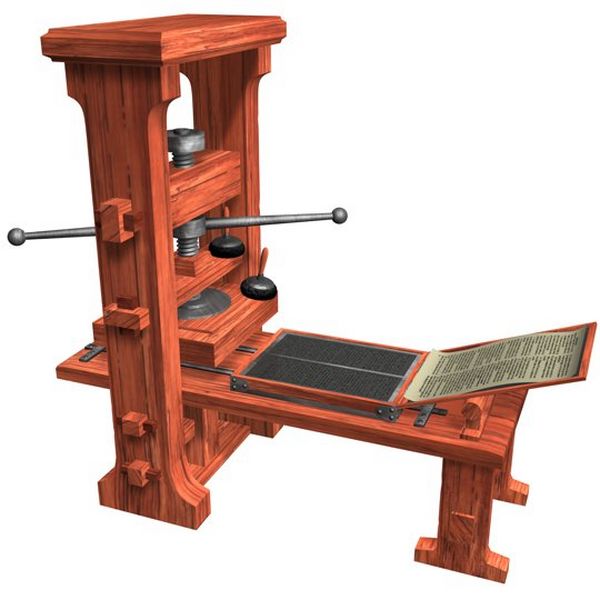
The printing press is an automated form of moveable type created by Johannes Gutenberg. While he was a pivotal piece in transforming printing technology, the Gutenberg printing press is the culmination of previously existing ideas that originated from various parts of the world. These pieces saw their roots in the East and, over a few centuries, eventually creeped their way into the West.

The first known form of printing technology was “block printing”, in which an entire page is carved into a wooden block in reverse and then pressed onto paper. The beginning of block printing is unknown but originated in China at least as early as 877 A.D., during the Tsung Dynasty. According to History.com, The first recorded printed book is The Diamond Sutra from Dunhuang, China.
The method utilized by the printing press is called “moveable type.” Moveable type was invented previously in China. It is, in essence, the usage of reusable wooden or metal “stamps” to quickly and easily produce words and characters on a page. The oldest long-form work made with the technique is Jikji, a book on Buddhism, printed in the Korea in 1377.
The next piece of the machine lies in the Mediterranean. Areas such as Italy, Greece, and Türkiye are known for their wine and olive oil production. The medieval method for extracting the grape juice and oil from the grapes and olives was a press. A handle was used to turn a screw that lowered a plate to apply even pressure across the surface of a bunch of the fruits at once.
This concept, as well as block printing, were utilized in Medieval Europe to invent the “paper press.” Instead of fruit, the paper press lays a piece of parchment across a carved and inked block, pressed evenly into it, and transferring the page.
Gutenberg’s press is considered a “flatbed press” in which the printing is done with two flat surfaces. Two cylinders rotate in opposite directions with typefaces curved around them. Paper is placed between them in one continuous strip.
These cylinders also introduced the possibility of color. Paper passes through various cylinders with different typefaces and inks in quick succession, allowing for different combinations to create colored pages.
Gutenberg Himself

The 15th Century was a revolutionary time for Europe. Control of information is one of the biggest ways in which the noble, ruling class stays in power. Most commoners were illiterate, which made it easier for those with power (who could read and write) to manipulate public opinion.
Johannes Gutenberg was a German son of a metalworker, born in the 14th century. He moved to France around 1428 and worked as a gem-cutter. He may have begun working on the printing press as early as 1438.
Gutenberg finished his first printed work in 1455 in Mainz, Germany. This product was the Gutenberg Bible, aka the forty-two line bible, in Latin. 48/180 still exist today, many of which can be found at museums and major libraries, such as the Morgan Museum and the New York Public Library.
Using preexisting technologies as a basis for his work does in no way detract from the extravagance of Gutenberg’s work and contribution. In fact, it’s a testament to creative thinking and the value in cultural exchange.
Beyond Gutenberg
Gutenberg’s printing press spread readily from Germany to Italy, France, Spain, and Portugal and all thorough Europe during the 1470s.
William Caxton was an English merchant and diplomat. In the 1470s he spent time in Cologne, Germany where he learned printing. When he returned to Burges, England, he set up a press with the help of Flemish Calligrapher Colard Mansion. He later went to London and established a press at Westminster.

In 1476, 20 years after Gutenberg’s initial invention, William Caxton established the first printing press in England. He translated and printed around 100 books, including religious texts and fictional tales, many of which can be found at the Morgan Library and Museum.
Caxton’s work set the standard for the English language, establishing the Midland London dialect. At this time, the nobility of England spoke French and scholars wrote in Latin. Caxton standardized spellings and occasionally introduced French words when the task was too difficult.
With a standard language, shared and spoken by the common people, it became much easier for people to educate themselves. Eventually, the mid-1800s saw Richard M. Hoe perfect the creation of a powered press, making the process faster and automatic. However, a combination of flatbed and rotary printing remained popular.
Then, the late 19th century saw the invention of off-set printing, which allowed for multiple different colors to be pressed at one time. This process involves paper being rotated through in one direction while being pressed up against a cylinder that holds the ink being rotated in the opposite direction. This method is still the standard for printing in the modern day.
Modern Kean Relevance
The printing press pioneered modern forms of type and publication.
“Modern printers are many iterations of technology after the printing press, but are just as essential,” Kevin Modeszto, editor-in-chief of Kean’s newspaper The Tower (which stopped printing physical copies at the end of 2024) said, “in my major, digital has really taken over…Printing was the gateway to what we have now, we wouldn’t have Microsoft Word or Canvas or anything like that without the printing press.”
Even though the world seems to be moving on to more online spaces, this doesn’t render physical copies worthless.
“Now that so many things are born digitally, I worry that as software updates and apps go obsolete, many historically valuable [things] can be lost,” Erin Alghandoor, an archivist here at Kean, says, “The collection [in Kean’s archives] contains floppy disks that are currently inaccessible and would require a lot of funding and work to gain access.”

Digital copies can never replace the value of a printing press or even a modern laser printer. The power and value of print is in how everybody can access a printer and published materials.
The invention of the printing made reading accessible to average people. Previously, it was only a skill for the ruling class that was abused to control public opinion. The printing press standardized language and spelling; making it easier to learn and allowing for ideas to be clearly portrayed and understood among people in different regions.
People no longer had to rely on only word-of mouth and whatever the literate ruling class deigned to tell people. It also made reading and writing physically accessible, with that came the ability to challenge authority. This was seen through figures such as Martin Luther and Copernicus, whose writings challenged doctrine from the Catholic church that was easily accessible to common people due to the printing press, despite the attempts of popes to prevent it.
“Print can last for hundreds of years. At SCRLA, we mend tears, unfold creases, and surface clean dirt off paper. We have a solid student newspaper collection, but we don’t have print versions of the recent digital issues,” Alghandoor said, “also, print is much more accessible than handwritten script. The evolution of the printing press to typewriters, personal computers, home printers, and smart phone messaging apps makes all content and material legible to other people. We find less people engaging with script material because they didn’t learn how to write or read it.”
Such ideas have remained crucial and relevant, with the Bill of Rights asserting the American people’s right to Press. This combined with the Freedom of Speech solidifies how the printing press’ significance found its way into the formation of laws and altered the rights assured to the general public in the United States alone. These are rights that can and are utilized by professionals and students alike every day, so long as they have access to a paper, a printer, and a computer. All things that may never have existed if Johannes Gutenberg never invented the printing press and given it to the people.
You must be logged in to post a comment.