By: Hajar Lababidi and Kevin Modeszto | Publish Date: May 1st, 2026
Kean University has many different campuses, from the flagship in Union to the new campus in Jersey City. But one is unlike the others. The satellite campus in Wenzhou, China allows for students and professors from both countries to experience a semester abroad.
Founded in 2014, Wenzhou-Kean (WKU) is the only public American university with a campus in China. In order to exchange, students must be at least a sophomore, have at least a 2.8 GPA, have zero financial obligations to Kean, among other requirements.

Dr. Wenli Yuan, the chairperson of the Department of Communications, Media, and Journalism, has done exchanges to WKU for teaching and academic collaboration. In March 2026, she led a Travelearn to the campus to promote cultural and academic exchanges.
“Kean USA has a long-established history, a diverse student population, and a vibrant campus life with numerous activities,” Yuan said. “In contrast, WKU is a newer institution with a smaller, more homogeneous student body.”
She described the experience as “eye-opening” for all students involved. “There was so much to take in, the food, the culture, the language, and the traditional clothing,” she said. “[Kean-USA students] were also impressed by the beauty of the WKU campus and especially enjoyed getting around on scooters.
The Tower spoke to several students and faculty members who have experienced Kean in both the U.S. and China. They discussed how the exchange introduced them to new ideas and experiences and transformed their academic journeys.
Exchange of Ideas
Yiran (Holden) Hu is a sophomore majoring in Communications-Public Relations. He is in his first semester as an exchange student at Kean Union. Hu spoke on being exposed to vastly different ideas of gender then he had been exposed to in China.
“(I was introduced to) a lot of LGBT+ ideas,” Hu said on his Intro to Women’s Studies class. “I think through these classes I can get a more 3D version of the world and a more critical vision to shape my own recognition.”

Hu elaborated, “gender and sex are two different concepts in the English language, but in Chinese the gender and the sex are the same word. I learned that sex is more biological and gender is more socialized.”
Fellow WKU exchangee, junior Psychology major Shengyang Li, shared a similar thought on being exposed to topics never discussed in the classroom. In China, she said, “we always avoid talking about something like (death).” Here in America, Li went on a field trip to a funeral home for her Death in Perspective class, which exposed her to a new way of thinking about life and death.
On the flip side, senior Amori Cross-Faulks, who is in Wenzhou for her final semester of college, recalled feelings rather than a tangible idea.
“My experiences here have made me more open minded and patient. It has also grown my interest in language learning, cultural immersion, and living abroad,” Cross-Faulks said. To her, “daily life in China is not much different to life in the US, but the small differences in culture have opened my eyes to new ways of living and appreciating others in a way I could not have gotten at home.”
Highlights
When asked for personal highlights, all four students shared stories of new friendships, as well as new experiences that were unavailable back home. Hu discussed skating and volleyball, Cross-Faulks discussed tours of Chinese monuments, and Li discussed the previously mentioned field trip. Communications-PR major, Zexiang (Jason) Dai, had a similar story about an NBA game in Philadelphia.
“During the team’s timeout, we have music and the camera will project the dancing audience in the stands onto the big screen. Among them, a child with Down Syndrome won (a) very warm applause,” Dai said. “Even when the game started, the camera remained on him, and the applause did not stop. This experience made me feel the United States pays more attention to caring for vulnerable groups, which is better than China’s.”

Kean professor Lydia Kaplan shared a different type of highlight – a bond between a crop of incoming WKU freshmen and their American professor. Kaplan traveled to WKU during summer to help the students adjust to an American classroom. To bond with her students, Kaplan would host a movie night in her classroom.
“I’d go to the supermarket, and they would look at me funny,” Kaplan said, “because it’s not like here where you can get big bags of potato chips. I would get snacks and candy, but like a million of them. They can come back to my classroom at night and we’d have movie night.”
The group grew so close that they ended the summer by taking a pebble and hiding it in a potted tree. That became their rock, their secret, a little token of the group’s summer together.
Yuan also shared a story of a personal bond between students and a foreigner.
“When we visited Yandang Mountain [a coastal mountain range in the Zhejiang region], our tour guide spoke very little English, yet he was energetic and humorous,” Yuan said. “Despite the language barrier, my students formed a genuine bond with him and truly enjoyed his company. Moments like this remind me that, as human beings, we share far more in common than it may initially seem.”
The Culture Shock
Despite exchanging from different countries, there was a common denominator between the greatest culture shocks Li and Kaplan experienced: Poverty. Li was shocked to see the sheer amount of homeless people in and around New York City. “I expected a few homeless [people], but in New York, [there was] so much, and also in Newark.”

Meanwhile, Kaplan was shocked by her observations in the difference in levels of wealth between the modern WKU campus and surrounding areas. “They might have a store with Versace in it,” she recalled. “But then there’s neighborhoods that are impoverished.”
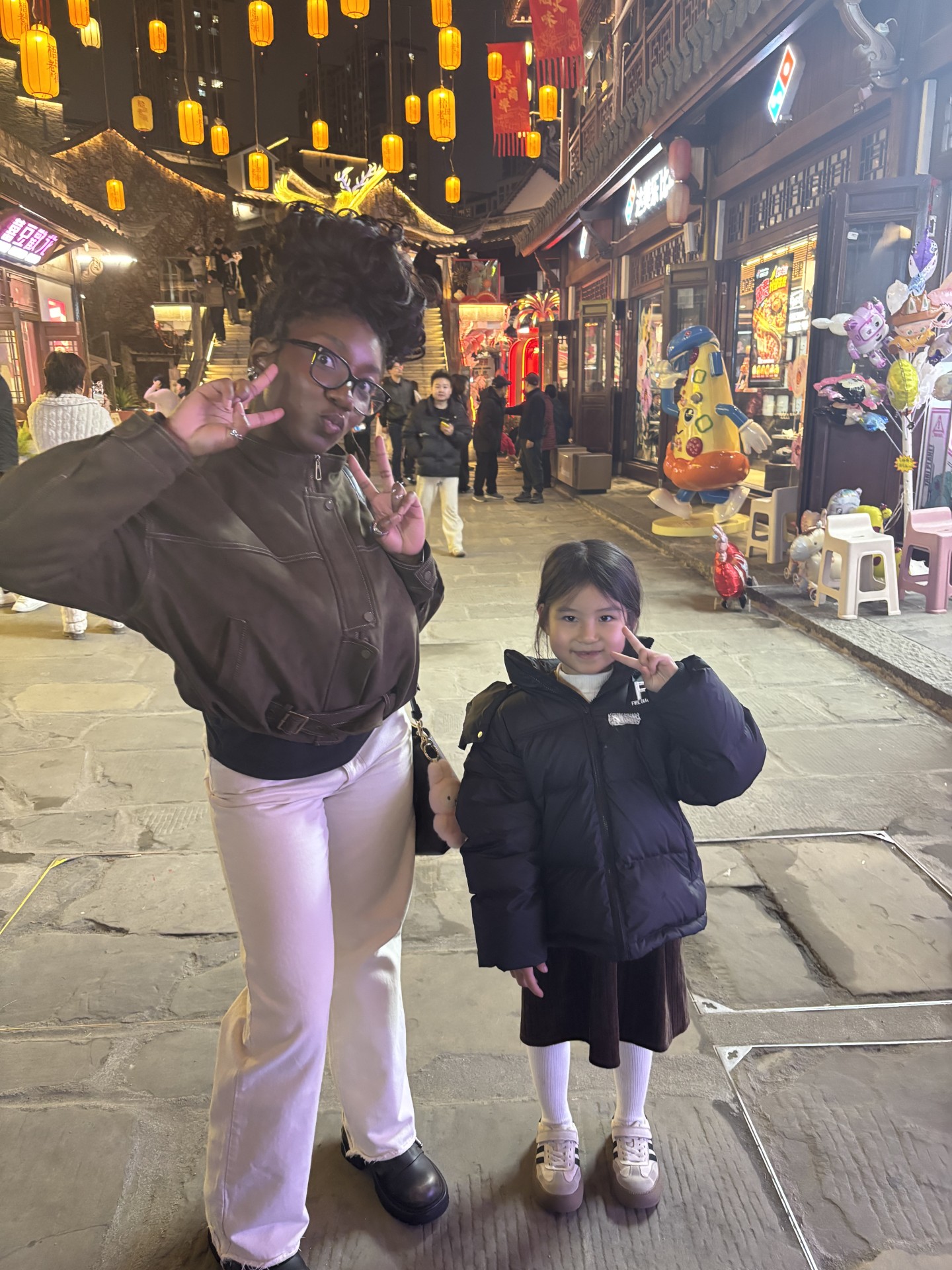
Cross-Faulks had her own experience sending and receiving culture shocks in her semester at Wenzhou. Being a Black American, she described how she felt especially scrutinized by people, who would stare and even try to take photos.
“People here also love getting their young children to practice speaking English with you and to take photos,” she said. “But if you ask them not to take photos of you, they understand. Chinese people are very polite and curious.”
Other shocks were less cultural and more routine-based. For example, Hu struggled to adjust to a lack of places that are open for 24 hours. The self-described “gym rat” found it difficult to adjust to Harwood Arena only being open 9 a.m. to 9 p.m., compared to it being open for 24 hours in WKU.
Hu and Li both shared struggles with communicating. Hu’s struggles were with how to respond to friends or professors attempting to make small talk, a concept more practiced in America than China, while Li’s were with speaking English in the classroom itself.
“Although our courses are in English, the classmates are all Chinese, so beyond the courses we will communicate (with ourselves and professors) in Chinese,” Li said, “but here (in America), all the classmates are foreigners. We need to communicate English with them.”
What Can Be Improved? What Can Be Learned?
All four students had suggestions for what people could learn from each campus and country.
Hu and Dai both agreed that Americans have a strong motivation to being at college in the first place. Hu noticed that Americans talk more in class and have a more positive attitude towards professors asking questions.

In addition, Dai noticed how Americans are motivated by their interests in college, rather than getting an A. “In China, most people study to obtain good grades and diplomas,” he explained. “But in [the U.S.], I found some people choosing the course because of interest.”
Meanwhile, Li noticed that Americans are more expressive of their emotions, compared to Chinese students who are shyer and more closed off.
“I think I will keep this habit (of expressing emotions),” Li said.
On the other hand, Cross-Faulks believes that it is Kean USA who needs to do more to get students driven.
“I think WKU does a great job at keeping students on track and engaged in their studies while preparing them for life after college,” Cross-Faulks said, “Kean USA has many programs and offices that aid in this, but students don’t use them until it is too late. I think WKU does more work in the classroom to connect you with real world situations and life outside the classroom, and the country.”
Yuan believes the two campuses should continue to learn from each other and collaborate, as they have been doing since WKU’s inception. “The two universities have already collaborated in a number of areas, including research, program development, and student exchange,” she said. “There is certainly more that can be done in the future.”
Conclusion
The privilege of spending time abroad is a privilege that was not lost on anyone that was interviewed for this story. Their exchange providing incredible and eye-opening experiences was a unanimous sentiment from all six interviewees.
Hu has enjoyed his time and studies so much, he chose to stay an extra semester in America. Li and Dai will be returning home after two and one semesters respectively after this current semester ends.
It is too late to apply for an exchange in the Fall 2026 semester, but in that semester, applications to exchange for Spring 2026 or future semesters will be open.
“I think that all professors everywhere not only in China would tell that having a multicultural class is the most rewarding component of an academic career,” fulltime WKU faculty member Ruth Gomes-Sobrino said. “Having students not only from the US but from other countries help to make classes more meaningful as especially in our degree we often explore diverse media ecosystems, international news and global communications.”
You must be logged in to post a comment.