By: Maxwell Burkey, PhD | Publish Date: April 28th, 2026
As Kean University students eagerly prepare for professional life and career trajectories, the school provides an opportunity for students to prepare for civic life in our democracy. One of our core values at Kean is “public impact”—engagement with one’s peers in addressing civic challenges and making a positive impact in our communities and institutions.

Those challenges can seem overwhelming, particularly at a time when American democracy is under duress. But Kean University students may be encouraged to know that there is a tradition of youth and student movements that have strengthened democracy in moments of peril. Indeed, it is difficult to imagine American democracy today without the contributions of students.
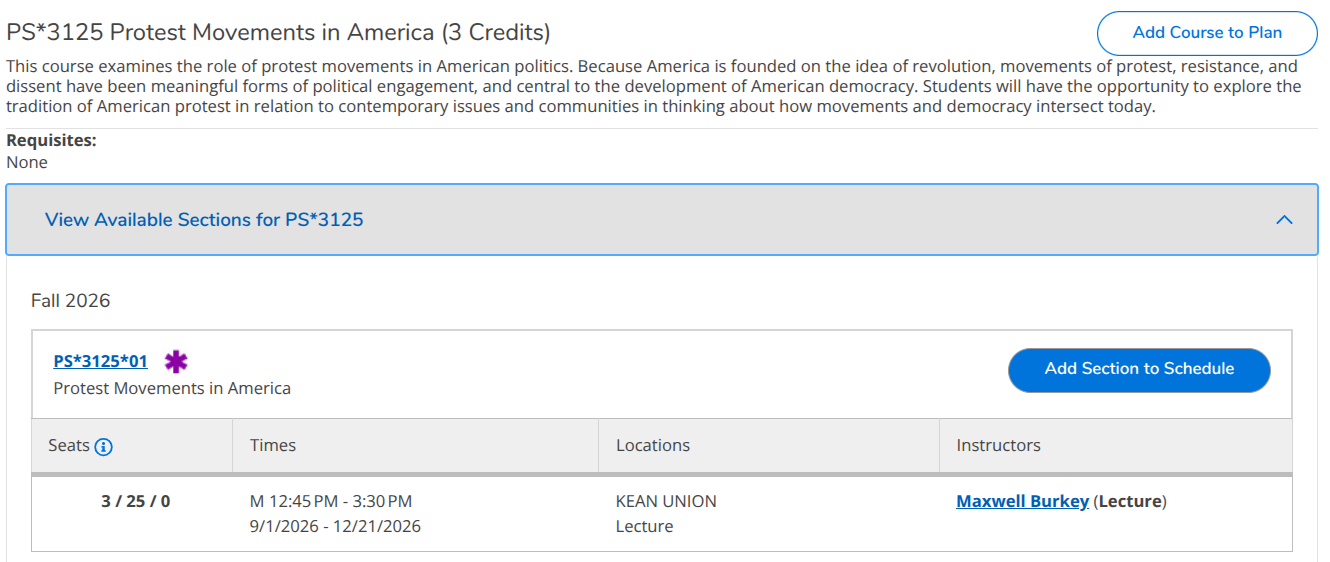
In the Fall 2026 semester, I will offer a new course at Kean University, PS 3125-01: Protest Movements in America, that will explore the contributions of student politics to American democracy.
“We are people of this generation, bred in at least modest comfort, housed now in universities, looking uncomfortably to the world we inherent,” read the first sentence of the Port Huron Statement, authored by the Students for a Democratic Society (SDS) in 1962.
The statement addressed student concerns in the 1960s, becoming a generational manifesto, and helping to spur student consciousness across a range of issues. There would be critical contributions from student-led movements in the arenas of civil rights and women’s rights, antiwar politics, environmental justice, and more. The students of SDS and those they spawned tied these civic goals to a broader quest for personal fulfillment and a meaningful life. How would a contemporary Port Huron Statement read, if written by Kean students?

In the summer of 1964, University students from around the country flocked to racially segregated Mississippi to challenge Jim Crow laws that prevented African Americans from voting. The students set up “Freedom Schools” to teach texts and histories that were barred from the state sanctioned curriculums of Mississippi schools, especially African American history. Students transformed their university general education curriculums into a form public engagement, contributing to the movement to end racial segregation in America and ensure voting rights for all citizens. When three students were murdered for their work on behalf of racial justice that summer the movement persisted, sending a racially integrated delegation—the Mississippi Freedom Democratic Party—to the Democratic National Convention in New Jersey. What form might a contemporary “Freedom Summer” take, if organized by Kean students?
These are some of the questions and student movements we will examine in PS 3125-01: Protest Movements in America in the Fall 2026 semester. We will also explore student activism in other areas, such as human rights, health care, and wellness. Political scientists often note that democracies rely on enlightening institutions that nurture public knowledge, truth, and reasoned argument, such as media and academic institutions. But our democracy is also indebted to student movements that have likewise brought light to issues and communities on the margins of national attention. In addition to the kind of education offered by Kean University, student activism has been a crucial way young Americans have realized their voices, engaged the public, and helped to create change in American democracy.
You must be logged in to post a comment.