By: Michael Mayhew | Publish Date: April 9th, 2026

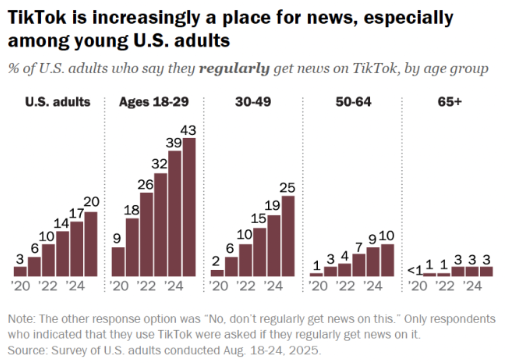
In recent years, younger people, particularly millennials have increasingly turned away from traditional media such as newspapers and cable news and instead rely on social media for information, especially TikTok. A survey conducted by Pew Research Center in September 2025 found that 43 percent of adults under 30 regularly get news from TikTok. In 2020, only 9 percent of adults under 30 said they used TikTok as a news source. The platform has also surpassed other social media platforms such as YouTube and Instagram for news consumption among young audiences. Many users prefer shorter, more authentic, and personality-driven content over traditional media.
TikTok’s algorithm has played a large role in delivering news to users. The platform pushes content through its “For You Page” (FYP), which relies on a personalized recommendation system rather than traditional social networks. The algorithm analyzes engagement such as likes, comments, and watch time on specific topics, hashtags, and sounds to predict user interest and distribute content rapidly, including from accounts that users might not follow.

Getting news from TikTok can have some benefits. The platform allows users to access short, digestible content and hear a wide range of perspectives from different creators. According to Pew Research Center, 35 percent of TikTok users say they have learned about news topics on the platform that they may not have encountered through traditional news outlets. Some users also feel that independent journalists on TikTok may be more trustworthy than journalists working for large corporate media organizations.
However, there are concerns about relying on TikTok for news. Because anyone can post on the platform, misinformation can be spread quickly without proper fact-checking. There has also been a growing presence of AI-generated videos on TikTok. In addition, about 80 percent of TikTok creators who produce news-related content are not trained journalists, but citizen journalists, meaning they lack experience in verifying information or properly fact-checking stories.
Critics also worry that TikTok’s algorithm may promote polarizing or emotionally charged content to users’ “For You Page” rather than balanced, fact-based reporting. Some observers have also raised concerns about the role of ByteDance, the company that owns TikTok, and whether it can influence the content that users see. Additionally, because TikTok videos are short-formed, viewers may not always receive the full context behind complex news stories.

Younger audiences turn to TikTok for news for several reasons. The platform is highly accessible, and videos often get straight to the point rather than beginning with lengthy introductions like traditional television news broadcasts. TikTok news creator Aaron Parnas believes that relatability plays a major role in why young audiences consume news on the platform.
“Younger audiences want news from people who look like them, sound like them, and meet them where they already are – on TikTok. I’m not afraid to admit when I’m wrong. The way you see me online is the way you see me in real life,” Parnas said in an interview with USA Today.
As more people continue to rely on TikTok for news, the platform’s influence on how information spreads is likely to grow. While TikTok can make news more accessible and engaging, questions about accuracy, credibility, and context will continue to shape discussions about its role in the future of journalism.
You must be logged in to post a comment.